
Early risk detection gives security and safety teams what disruption takes away: options. The faster they verify what’s happening, understand impact and act, the more control they keep.
An early alert to a crisis is now a hard requirement, but it is only valuable if the organisation can act on it with corresponding speed.
Security and safety teams may detect a disruption within minutes, yet still lose critical time verifying reports, identifying exposed people and assets, briefing stakeholders and moving information into response workflows.
Every extra minute of warning is time security teams can use to shape a better outcome. With verified, contextual information, teams gain room to assess exposure, contact local stakeholders and prepare their response. When it arrives late, that room narrows, sometimes closing before the organisation even has a meaningful opportunity to act.
A few extra minutes can be the difference between rerouting a traveller and managing an emergency extraction, securing a site and evacuating it, or warning employees and explaining what happened afterwards.
The value of early awareness is the decision time the alert preserves.
Now, this does not mean security teams simply need more alerts. In fact, the wrong system can send high volumes of low-quality notifications that create additional triage work and can obscure the event that matters. Furthermore, teams need full context, impact assessments and recommended action just as fast as they need to know something has gone wrong. The challenge the entire industry faces is that these are often disconnected systems and tools that analysts jump between to get to a place where action can be taken.
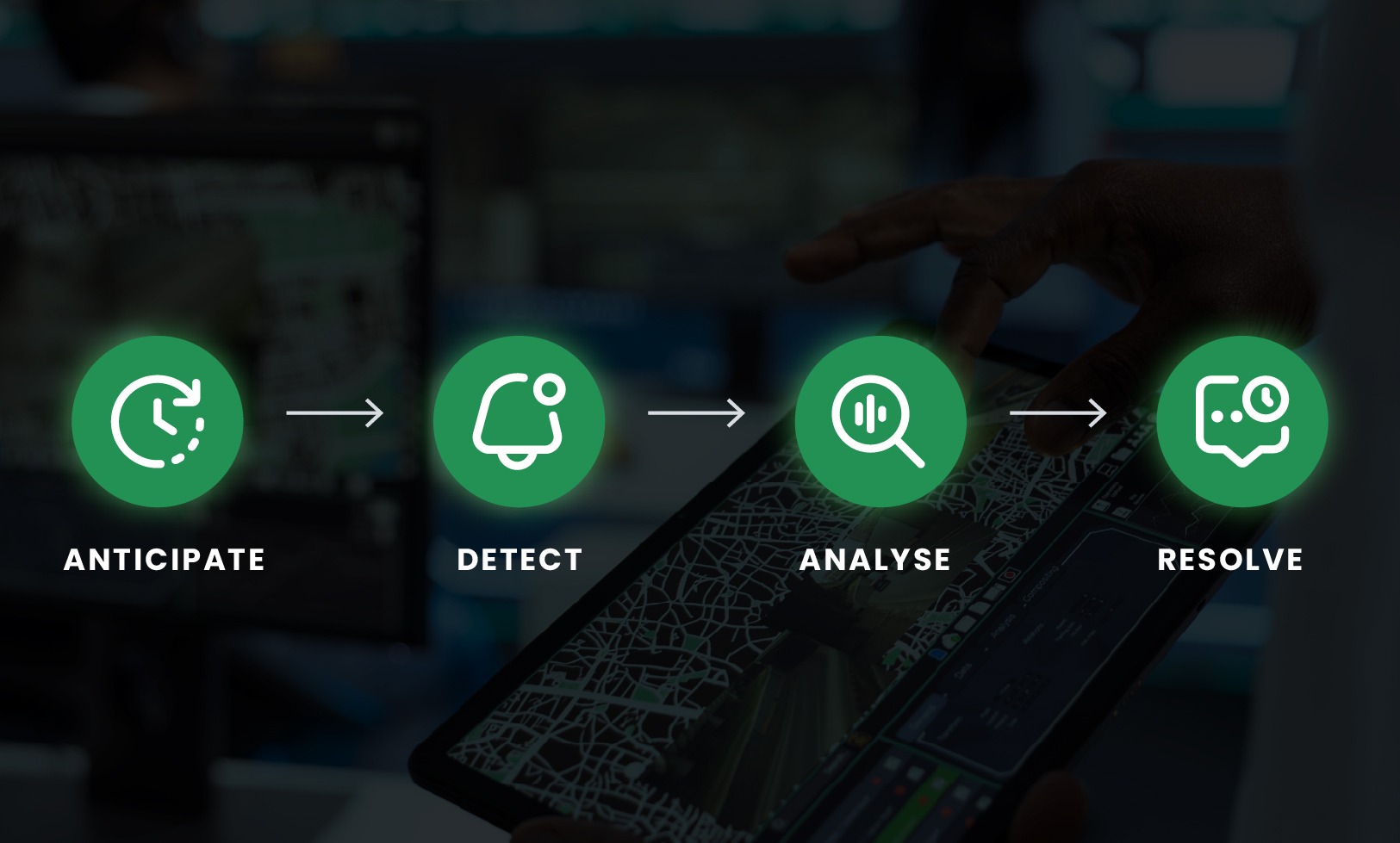
At Samesk, we describe this connected operating sequence as ADAR: Anticipate, Detect, Analyse, and Resolve. And we believe AI, particularly Agentic AI, is the key to implementing risk mitigation strategies that work at scale. Let’s unpack each part of the cycle and look at how Agentic AI completes the loop.
Anticipate the pressure
The strongest response often begins before the incident does.
Security teams can build decision space in advance by understanding historical patterns, planned activity, severe weather, geopolitical developments and known organisational exposure. This preparation helps establish thresholds, responsibilities and response options before the pressure of an actual disruption arrives.
Anticipation can’t predict every event, of course, but it does remove the need to start from zero when one occurs.
Detect what matters
Detection means you are now moving from anticipation into action – things are happening that now require you to act.
Modern incidents often surface through fragmented reports, images, posts and local updates before official confirmation. AI can help identify patterns across this information, consolidate related signals and surface an emerging event quickly.
Human verification remains critical. Analysts can corroborate reports, assess source credibility and distinguish a genuine incident from misinformation, duplication or unrelated noise. But crucially, this human in the loop must be fully integrated with the AI – buying more and more data feeds and using humans to triage false positives is net negative on your programme.
The objective is precision rather than volume: alerts that warrant attention, delivered early enough to preserve the opportunity to act.
Analyse organisational impact
Once an event has been detected, the next question is not simply, “What happened?”
You need to know, “What does this mean for us?”
Answering it means connecting external information to the organisation’s own people, assets, facilities, travel, suppliers and operations.
An incident may be significant in the wider world but have little direct impact on the organisation. Conversely, a smaller local event may require immediate intervention if it affects a critical site, route or traveller.
Agentic AI can accelerate this work by correlating incident data with internal locations, routes and operational information. It can help teams identify exposure, estimate likely impact and prioritise the areas that need attention.
A strong assessment should quickly establish:
- What is known and how confident the team is
- Which people, assets or operations are exposed
- How the situation could develop
- Which decisions may be required
- Who needs to be briefed
This is where situational awareness becomes operational understanding.
Resolve through workflows
Understanding changes nothing until it reaches the people who can act on it.
Resolution carries verified information and assessed impact into the procedures a team already has. Depending on the incident, this may involve rerouting travellers, closing a facility, notifying employees, pausing local activity or escalating to crisis management.
AI agents and workflow automation can support this stage by preparing briefs, routing alerts and initiating actions against standard operating procedures. They can reduce repetitive manual work and carry consistent context across email, messaging, mapping and incident-management systems.
With Agentic workflows we are now moving away from static procedures and playbooks that rarely work for today’s ever changing risk landscape. This means the workflow is as dynamic as the risk itself.
ADAR: One connected system
ADAR provides a clear structure for the operational lifecycle of managing threats and disruptive events: Anticipate, Detect, Analyse, Resolve.
The value of the model comes from the way those stages work together:
- Anticipation gives teams a clearer starting point before pressure arrives.
- Detection creates the earliest possible awareness of an emerging incident.
- Analysis connects that incident to the organisation’s people, assets and operations.
- Resolution carries that understanding into the workflows and decisions that determine what happens next.
If any of the stages are removed, the response is weakened. ADAR links awareness, context and action so security teams have the best chance of protecting people, maintaining operations and improving the outcome. With AI agents ADAR can be operationalised for any org, big or small to create a next generation programme that was previously not thought possible.
James Neufeld, founder and CEO, samdesk
 James Neufeld is the founder and CEO of samdesk, the AI operating system for modern GSOCs. He leads samdesk’s work with security and risk teams to detect emerging incidents, verify them in real time, and deliver incident-level context mapped to people, assets, and operations – helping organizations close the gap between first signal and coordinated action.
