
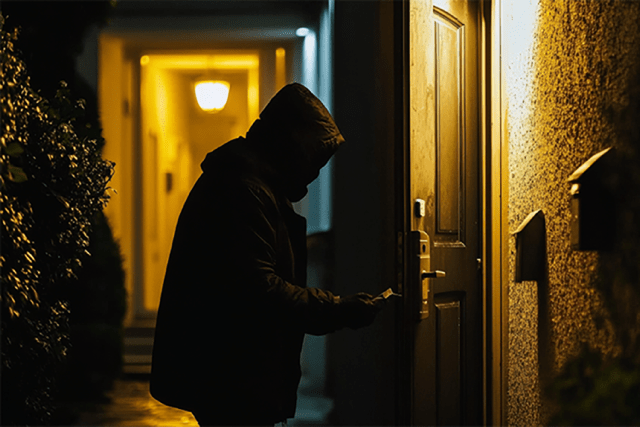
AI security should not replace physical security in the home
Artificial Intelligence is a hot topic in today’s security landscape, including in home security. While implementing AI into a home security system has immense benefits, it should not be used in place of physical security systems, but rather alongside them. In this article, Titan Security Europe outlines how AI security works, its blindspots, and how physical security covers them.
Function of AI in home security
AI can be used in a number of ways in security:
CCTV
- A CCTV system that is not powered by AI can alert homeowners to any movement outside of their home. While this is useful in cases of an intruder, homeowners don’t tend to want to be alerted every time the neighbourhood cat passes in front of the house.
- Using machine learning and behavioural analytics, AI can make decisions on whether a movement is a threat – an intruder – or harmless – such as a parcel being delivered – and act accordingly.
Detecting Behavioural Anomalies
- An AI security system will know the patterns of your home and surrounding area, and be able to identify anomalies in behaviours of the area.
- It will recognise unnatural happenings – such as the sound of glass breaking – and can trigger an alert to homeowners or even contact emergency services to potential crimes in the area.
People/Vehicle Recognition
- AI security systems can use facial recognition systems to protect a home. It will learn the faces of homeowners, family and friends.
- If the system catches a face it does not recognise, it will alert the homeowners to the presence of what it perceives as a stranger.
- AI-powered smart security systems can also learn to recognise the vehicles that usually pass in front of a residence.
- As a result, if an unknown vehicle stops by, the security system can alert the homeowners that an unknown vehicle is at their property.
Routine Memorisation
- Much like an AI system can learn faces, it can also use behavioural analytics to learn the routines of homeowners and frequent visitors.
- This means that the system knows who comes and goes and when and is able to detect anomalies by linking routines to faces.
- This can allow the system to alert homeowners if the wrong person is trying to get into the home at the wrong time, according to its previous analysis.
Geofencing
- Geofencing is the visual boundary that informs an AI system of the area it needs to monitor. Once someone or something crosses this boundary, the AI system will analyse whether it is normal (a homeowner, a family member or friend, a delivery) or a threat (an intruder, someone dangerous to the homeowners).
- A geofence can detect mobile devices, too – if a thief or other threat enters the geofenced are with a personal device, authorities can be informed of the threat’s identity.
AI Security’s Weaknesses
Dependency on Connection
- Most AI security systems depend on the Cloud – around 70%, according to a 2023 Deloitte study. Dependency on an internet-based service can be a major weakness to a security system, as a simple outage in connection can cause the whole system to come down.
Recognition Failure
- A lot of AI security systems depend on facial recognition or biometric systems to allow people to enter a home. However, there can be failures in this recognition. Factors such as age, lighting, alterations such as makeup and more can cause an AI system to not recognise a homeowner, and thus detect them as a threat.
- Interestingly, there seems to be some bias in this. In 2018, researchers at MIT carried out an experiment that showed a 34.7% recognition error rate for dark-skinned women and only 0.8% for light-skinned men.
False Positive
- Following on from recognition failure, AI can make falsely positive responses that allow people who are not registered into the system to enter the home without incident. According to research by Ponemon-Sullivan, there was an an average of 9.854 false positives generated by AI security tools in a typical week.
What Physical Security Can Do
CCTV
- While CCTV can be improved with AI-powered technology, it is advisable that CCTV does not rely entirely on AI, as AI systems can go down the moment a connection fails, which could lead to major security breaches.
- Physical CCTV systems – which can be enhanced with AI without being connected via the Cloud – are only at risk of going down in a power outage. However, these systems can be connected to an Uninterruptible Power Supply (UPS) or a backup generator to provide them with power in times of outages.
- As a result, CCTV can still run even when the Cloud connection goes down and during a power outage, thus meaning the home is still monitored – if without the AI enhanced power.
Access Control
- Recognition or AI system failures can lead to homeowners being kept out of their own homes if entry to the home is dependent entirely on the system – for example, if a vehicle or face needs to be recognised in order for access to a gated estate to be granted.
- Access control should therefore not rely entirely on AI recognition. Homeowners with gated estates or AI-enhanced access control to their home that do not possess keys should also have codes or fingerprinting systems that are not connected to their AI system to allow access. With this physical backup, should the AI system fail to recognise a homeowner, they can still gain access to their home.
- This would also prevent false alarms if a homeowner’s friend or family member were to go over to the home with permission of the homeowner while they were away.
Intruder Alarms
- For instances where every part of a security system has failed, from recognition of the threat to prevention of entry, intruder alarms connected to the homeowner and the authorities should be in place within the home.
- These alarms should not be connected to the AI system – in case of outage – and would be able to be switched off by the homeowner or trusted guest entering a previously set code. For maximum safety, this code should be changed often – around once a month.
- This layer of security acts as the final defence. If everything else fails, intruders will still be caught out on entering the home.
With all the benefits of including AI in a home security system, it is certainly beneficial to implement. AI can recognise faces, trigger automated responses, and monitor behaviour at a far more effective rate than regular systems. However, it is imperative that homeowners know how to mitigate the many risks of using AI in security – such as recognition failure – to ensure that their home security is not corrupted.
Homeowners should not rely entirely on AI security given the risks. While AI can improve physical systems such as CCTV, homeowners should still have physical security measures running alongside the AI. Physical security covers the blindspots of AI and can also run even if the AI system goes down, ensuring complete and total protection of the home regardless of circumstance.
