
Protecting iconic institutions
Scott Hamer, Head of Security and Resilience at St. Paul’s Cathedral and former personal protection officer to HM The King (as HRH The Prince of Wales), discusses his security career and the nuances of protecting and securing iconic people and institutions.
Initial career path
I started my security career in 1992 as a police constable in the Metropolitan Police, serving at Paddington Green Police Station. The early and mid 90s saw a heavy bombing campaign in London from the IRA and dealing with bomb threats, suspicious devices and real IEDs became as routine as dealing with thefts, assaults and accidents.
In fact, I witnessed my first explosion only a couple of months out of Hendon Training School. One Saturday morning, just before nine o’clock, we received a coded bomb threat from the IRA stating that a bomb had been planted at Paddington Station. This was shortly followed by one of my sergeants on the radio saying he wasn’t happy with a bag he had found in the telephone box outside the police station.
I saw a couple of my colleagues arrive in that area and they started to clear the street. At 0900hrs exactly I saw the bomb explode and felt the blast slap me on my chest. If my sergeant hadn’t found that bomb, I would have been walking past it at the exact time it exploded. The surrounding shop windows were blown in, a couple of my colleagues were knocked off their feet and the roof of the telephone box ended up on the roof of the police station. Thankfully, only one person was injured. It could have been much worse. Due to the ‘misinformation’, most of our police officers were at Paddington Railway Station searching and clearing that.
This incident certainly taught me a few lessons in security and self-preservation! Respect explosives, or suspect devices, and create distance. Never automatically believe everything you are told. It might be false. It might be mistaken. Assume nothing, believe no one and check everything. Explosions are nothing like they are in the movies. I was never again blasé when dealing with suspect devices.
As Paddington Green was the high security police station, it regularly housed IRA and other terrorist prisoners. As gaoler I would see them, up close, in the flesh as I carried out my duties, which included giving them food and cups of tea. They looked like very ordinary people, incredibly ordinary and nothing like what I thought a terrorist would look like. Come to think of it, I never arrested a burglar in a stripy jumper either! Another valuable security lesson: criminals, terrorists and those up to no good just look exactly like everyone else.
Royalty protection
In 2000 I applied to join Specialist Operations 14 (SO14), more commonly referred to as Royalty Protection. I passed all the tests and in January 2001 I found myself on my Reactive Protection (Bodyguard) Course at a former RAF base to the west of London. It was two weeks and very long days of ‘conflict management’, unarmed combat, one-handed shooting, performance under pressure and encountering every other conceivable attack against the person one could possibly imagine. It certainly wasn’t an easy course and a couple of people were lost along the way due to injuries.
Having passed that, I awaited my VIPER course, internally referred to as ‘the knives and forks course’. This brought us back down to reality and prepared us for reality and the 99% of the role – planning and preparation, reconnaissance, multi-tasking, teamwork, briefings, coping with last-minute changes, etc. This culminated in a final exercise looking after a ‘VIP’ for three whole days.
I remember our final exercise well. Whilst I was one of the CPOs waiting outside the Tate Gallery on 11 September 2001 we heard the news about the attack on the Twin Towers in New York. When I reported the news to my colleague over the radio he questioned whether this was part of the scenario!
Just weeks later, due to the increase in the terrorism threat, all those who passed the course were whisked into either Royalty or Special Branch protection roles and my protection career started.
I spent three years as a ‘back up’ close protection officer to the Royal Family and had the privilege of working with some of the original officers who were recruited into the department in 1974 after the attempted abduction of Princess Anne on The Mall.
I learnt a lot. I learnt that textbook protection did not necessarily relate to real-world protection. Principals’ wishes featured heavily in what we could and could not provide. The people we looked after wanted interaction with the public and this carries risks. Everything was about managing the risks, and compromises had to be made.
I often chuckle when many LinkedIn security ‘experts’ chip in with their thoughts on what should have been done in a personal protection incident or security scenario having never worked at that level. The reality is very different to the course or the theory.
Personal protection is a massive imposition on an individual’s life. Some people have to have it from birth to death. Most likely, you won’t be their first ever protection officer! They have a lot of protection experience themselves. There has to be compromise, trust and a certain spark for it all to work. It has to be discreet and unobtrusive. You have to wrap security around what they want to do. You are working to their objectives, not yours. Security isn’t their main concern, it’s yours.
After a promotion to inspector and a few years back on the streets doing some ‘real policing’, I returned to what was then SO1 (Specialist Protection). This was the former Special Branch ‘A Squad’. Whilst there I looked after many government ministers and some high-profile heads of state from around the world. Looking after Nelson Mandela for his 90th birthday was an absolute privilege. Likewise, looking after President Obama on two occasions.
I was also a Team Leader for UK protection operations to high threat countries around the world. In total I have delivered security operations in over 50 countries.
In 2015, I returned to Royalty Protection and was assigned to the then Prince of Wales’s team as one of his Personal Protection Officers, spending five years with him.
Life after the police and transition to the private sector
In 2021 I was part of a small team providing security to Team GB in Tokyo for the Olympic Games, and in 2022 I was the Venue Security Manager for the Alexander Stadium for the Commonwealth Games in Birmingham, responsible for the opening and closing ceremonies.
Later in 2022 I joined the team at the world-renowned Royal Albert Hall as the Senior Strategic Security Manager, leading the internal security team and the contracted external security provider. With over 400 shows per year, and some of the world’s most famous artists wanting to play the venue, this provided many security challenges.
Move to the City
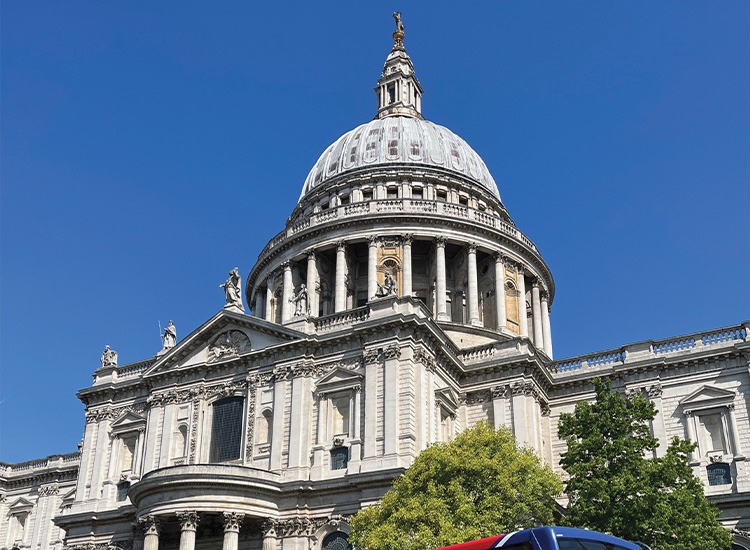
In April 2025, I moved to The City and started at another of London’s iconic domed venues – St. Paul’s Cathedral – as Head of Security and Resilience. Whilst having similar visitor numbers per year to the Royal Albert Hall, the security challenges are very different.
Although it is one of the busiest visitor attractions in the UK it is also, foremost, a working church and place of worship. This brings its own unique security challenges and there are similarities to my former work with the Royal Family, particularly relating to mental health issues.
Security needs to be in place as there was a thwarted plot to bomb the cathedral in 2019, but it also needs to be discreet and unobtrusive, blending into the background where possible, but equally needing to be seen and offer reassurance and a response when required – much like my role in the police. Symbiotic collaborations are required, a realistic assessment of the threats and risks, and then wrapping a realistic security solution around daily business that is proportionate and provides best value.
Having worked in this bespoke arena of security for many years, this ‘compassionate’ or collaborative style has benefitted me for my non-police roles. Both the Royal Albert Hall and St. Paul’s Cathedral are iconic and listed buildings. Imposing ‘ideal’ or textbook security upon these two places just isn’t possible. Yes, 21st-century mitigations are required against 21st-century crime and terrorism methodologies, but these have to be done in a sympathetic manner so as to blend in with the surroundings and architecture.
This requires some creative and specialist thinking. Due to my connections and projects completed in the police, I have been able to implement very discreet and unobtrusive security measures that most people would be unaware of at these two venues. Having high fences, standard CCTV cameras and conventional Hostile Vehicle Mitigation would just not be in keeping with iconic Grade I or II listed buildings. Threats need to be mitigated in other creative ways.
Collaboration with the local police is very important. That was quite easy at the Royal Albert Hall; being ex-Met myself, I was often working with many of my former colleagues. There was still a strong connection to my old department with the regular visits we would receive from HM the King, other members of the Royal Family and internationally protected VIPs for events such as the Festival of Remembrance and the Royal Variety Show.
There is a strong connection at St. Paul’s Cathedral with royal visits and state occasions, with events such as the recent 7/7 20th anniversary and the 80th anniversary of VJ Day. I am establishing new connections in the City of London Police, and have been very impressed thus far with the strong, established links we have with them and their very prompt responses to any incidents at the cathedral.
As with the Royal Family, the church does occasionally attract people with mental health problems, and there are a few individuals with fixations on the Bishop of London. Having experience in this area and connections within the Fixated Threat Assessment Centre (FTAC) has proved beneficial already in my new role.
Security is often seen as a ‘hard’ skill and is often imposed on something or someone. Many people in security have quite black and white views on what should and shouldn’t be done, particularly in close protection. Following any high-profile attack or incident, there will be a myriad of ‘experts’ giving their opinions on what could’ve and should’ve been done.
The reality is somewhat different! In royal and governmental security, principals’ wishes will feature heavily in the sort of security that will be accepted and tolerated. Compromises have to be made for security to be effective. If the person will not accept security in a certain form, there will be no effective security.
Scott Hamer
Head of Security and Resilience
St. Paul’s Cathedral
