
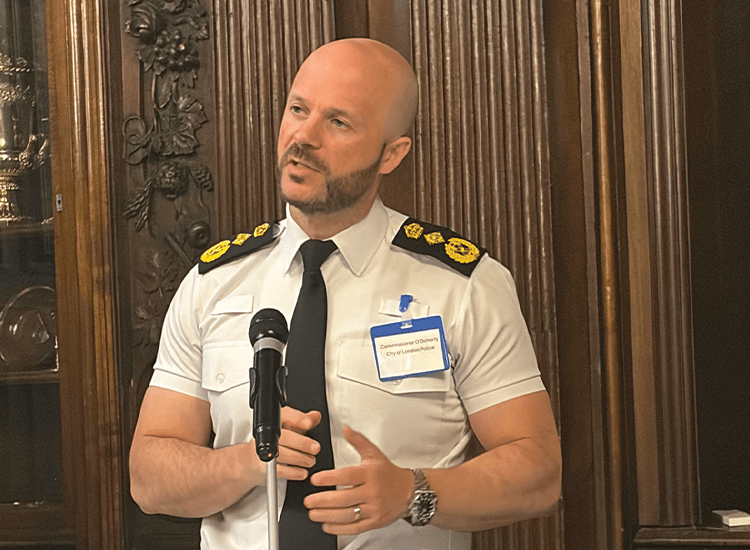
City of London Police Commissioner Peter O’Doherty speaks at CoLCPA AGM
The City of London Crime Prevention Association (CoLCPA) held its Annual General Meeting in May 2026 at the historic Vintners’ Hall. Keynote speakers were Commissioner Peter O’Doherty of the City of London Police and Tijs Broeke, Chair of the City of London Police Authority.
The formal business of the AGM included the re-election of Don Randall MBE as Chairman, alongside the appointment of officers and committee members. The existing committee was re-elected en bloc, reflecting strong continuity within the Association.
In his Chairman’s report, Don Randall highlighted the importance of governance, accountability, and partnership working. He also reflected on the continued success of the City Security magazine and thanked partners across policing and the business community for their sustained support.
The central focus of the event, however, was the contribution from Commissioner Peter O’Doherty, who provided a comprehensive overview of policing challenges and achievements over the past year.
The Commissioner outlined four key pressures shaping policing in the City: the UK national terrorism threat level at Severe (meaning an attack is highly likely), a 60% rise in protest activity, the growing scale and complexity of cyber crime, and the current focus on police reform. He also pointed to the rising influence of hostile states and the impact of misinformation, describing the current environment as a form of “modern warfare” played out across digital and physical spaces.
Despite these challenges, the Commissioner emphasised that it had been a strong year for the City of London Police. He highlighted a 7% overall reduction in crime, including an 11% decrease in theft, alongside significant progress in tackling phone snatching, criminal damage, and organised drug networks.
Partnership working remains central to this success. Initiatives such as the Our Safer City programme continue to evolve; the City of London community safety team are co-located with their police colleagues, and work with academic partners helps to identify hotspot locations and deploy targeted interventions. The Commissioner also highlighted the recent launch of upgraded Safer City police boxes as a visible commitment to community engagement.
The Commissioner drew particular attention to efforts to improve safety in the night-time economy, including Operation Reframe, which focuses on protecting women and girls. Innovative approaches to issues such as drink spiking, and using tactics adapted from counter-terrorism policing (Operation Servator) to spot predatory behaviour demonstrate a commitment to proactive prevention.
Cyber security also remains a priority, with the Cyber Griffin programme having trained over 90,000 individuals in the past eight years. Meanwhile, national leadership in fraud continues to deliver results, with hundreds of arrests and millions of pounds in criminal assets seized.
Turning to the future, Commissioner O’Doherty addressed the national conversation on police reform. While acknowledging the need for greater consistency and efficiency across police services, he made a clear case for the continued independence of the City of London Police, given its unique national role in economic and fraud crime.
This position was strongly supported by Tijs Broeke, Chair of the City of London Police Authority, who closed the session by reaffirming his commitment to preserving the City of London Police within any future restructuring. He praised CoLCPA’s long-standing contribution to crime prevention and partnership working, highlighting initiatives such as Safe Havens, the Our Safer City Pledge, and bystander intervention campaigns.